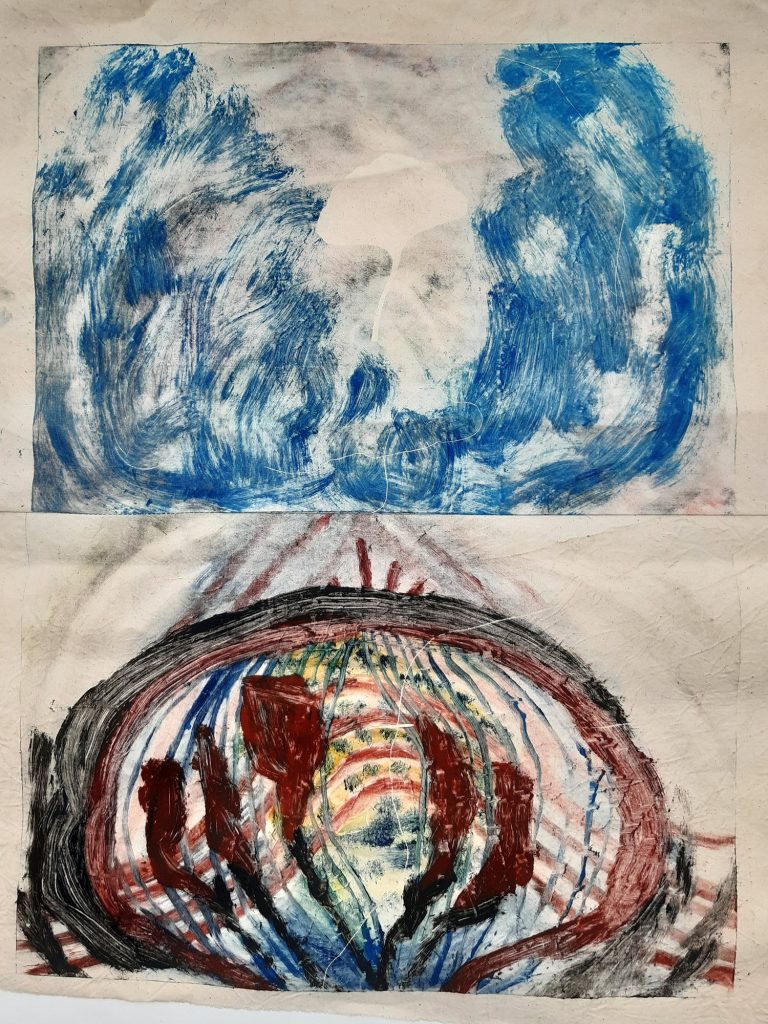
First draft
Whilst making these monoprints I found it hard to maintain a tight method, especially copying such a layered, gestural work. I use tight to mean: accurate, repeatable, accumulative or able to refine directly. I’m thinking of this in relation to my regular use of digital working files that can be versioned, reversed, pulled apart, made of discreet parts. Monoprinting in this painterly manner seems to work in opposition to this, rather than allowing me to refine a work as a retraceable set of actions it means each refinement of method produces a single, unalterable work. There is also a lack of mechanisation throughout the process, except for the pressure used on the press, which means there are a large number of manual controls which impact the print.
As I printed I found it unexpectedly difficult to forsee how a painted plate would print, something I have not experienced with other printing methods such as: Riso, digital, offset, letterpress or lino. This is obviously due to my lack of experience, but I suspect the element of surprise does not entirely disappear through practice. As I tried to mimic this artwork through compositional correctness (i.e. tracing it), the less it replicated the gestural tone of the work, which I found an interesting situation. From what I can tell this was due to the slowness of my brushstrokes when focused on accurate size and shapes, which meant the marks did not look as accurate in terms of fluidity of gesture or colour when printed.
I will begin to iterate by taking multiple pulls from a painted plate, this will help me to further question monoprinting in terms of its inability to produce accurate multiples, which in turn makes it non-viable commercially and somewhat explains its use/status within art (rather than design). I’ll also be looking to see what unexpected aspects of the method surface through iterations that degrade the image.
Second draft
Whilst making my monoprint copies I found it hard to maintain a tight method, especially copying such a layered, gestural work. I use tight to mean: accurate, repeatable or able to refine in a direct way. I’m thinking of this in relation to my regular use of digital working files that can be versioned, reversed, pulled apart—made of discreet parts. This painterly monoprinting works in opposition to this, rather than allowing me to refine a work as a retraceable set of actions it means each refinement of method produces a single, unalterable work. There is also a lack of mechanisation throughout the process, except for the pressure used on the press, which means there are a large number of variables impacting each print.
I found it unexpectedly difficult to forsee how a painted plate would print, something I have not experienced with other printing methods I am familiar with. To counter this I tried tracing the original, and found that made my copy less accurate. When tracing my brushstrokes where slower, resulting in overworked and heavier paint application which meant those prints did not replicate the fluidity of gesture or colour. What is accuracy within the work I’ve chosen to copy, something soft, gestural, imprecise? This led me to question the role of accuracy in print and communication and to experiment with repeated pulls from a plate to see what the limits of painterly monoprinting are within those terms.
Initially I iterated to degrade or exhaust the image. I began by working in layers to build up to the full image, pulling a print in-between to recreate the variety in depth of the original. Thinking about these iterations alongside Blauvelt (2013) what do they surface in reference to modern design’s “exercise in communicating intentions” for mechanical reproduction? What does the degradation of accuracy through repeated printing of the plate produce if viewed through that lens and how might it also approach a more “open system” (Blauvelt, 2013)?
To further experiment I created parameters to produce a new iteration— five steps consisting of loosely traced line drawings (1:2 scale) and instructions on colour use. My intention is to provide a compositional framework which allows for gestural fluidity and layering that utilises the degradation of the plate in each pulled print.
In this case accuracy is not about precision in multiple, but about an accuracy of achieving gestural fluidity, not the same print each time, but not an entirely different print either. Perhaps this is just an anachronistic process, not unlike a production line of hand painted ceramics where the painter follows a designed plan but where there is space for an amount of intuition (subjectivity) to come through. Can I evolve the parameters to produce a more open-ended system for a kind of gestural accuracy that plays on the degradation of the method?
Leave a Reply