For my second dialogue I reached out Heiba Lamara, co-founder of Rabbits Road Press, assistant editor of One of My Kind (OOMK), artist, publisher and market gardener. I felt that our shared skills, particularly the combination of print publishing and food growing in community settings would provide a solid base for in depth discussion.
I met Heiba at her studio, though I’d desperately wanted to meet with her outdoors, in a growing space that either one of us was connected to, but that wasn’t feasible. I’d given Heiba a short run down of what I wanted our dialogue to respond to: our experiences working with our shared skill sets of food growing (and gardening) and print publishing, how each of us experienced the connections as well as the frustrations between these.
I took Heiba an offering of farm grown runner beans, kale and tomatillos and a collection of second hand and self published books and zines for a Palestinian agricultural fundraiser she was organising. That exchange began our dialogue on the topics of horticultural labour, community growing projects, print publishing and design.
We spoke of the ways that working with our hands provides a space for conversation with others, importantly with near strangers, about our relationship to “nature” (and in many senses the more-than-human world) and how shifts in that relation reverberate through our social and political conditions (and vice versa).
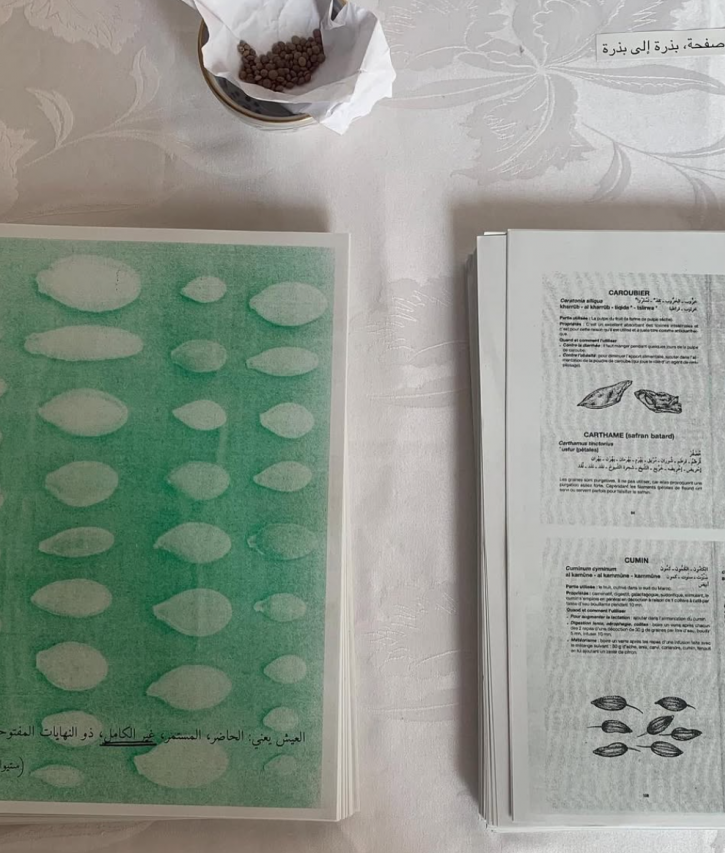
Heiba shared some of the collages and final publications that had come from workshops she’d facilitated, particularly a zine making workshop she ran at the Gaia Foundation’s seed sovereignty event in Wales in 2025 and publication pages made with The Gifted Mothers of Dar Bellarj during a workshop she did at Harvest Marrakech.
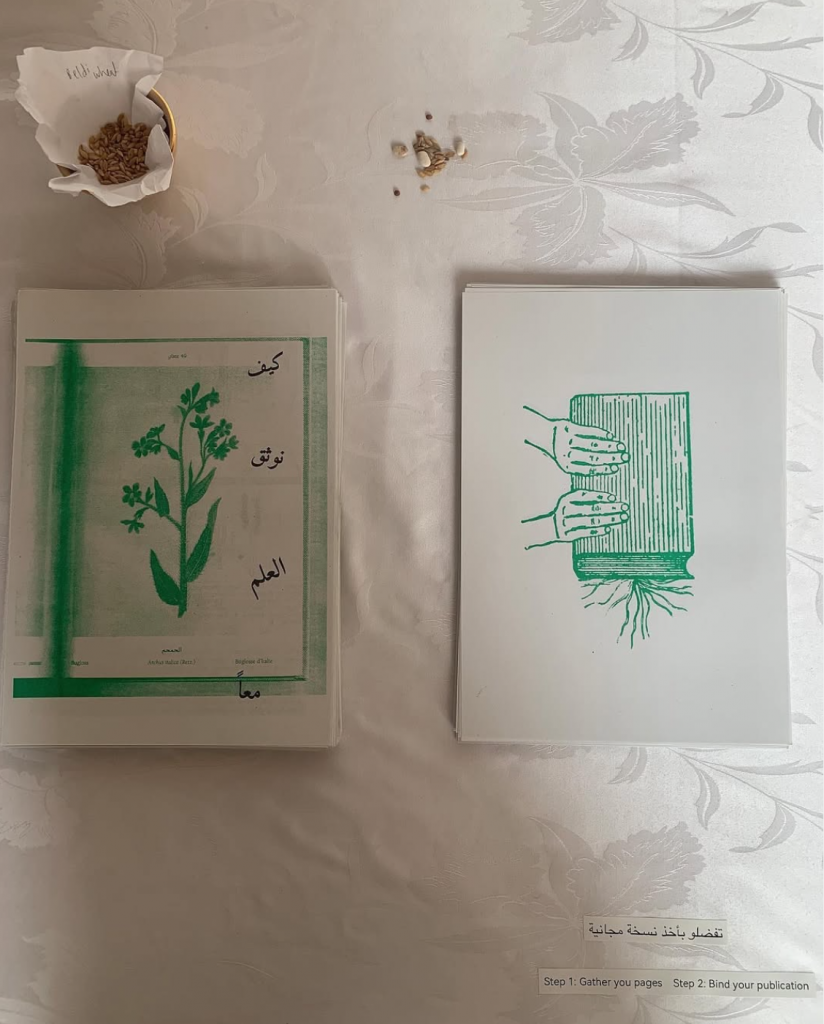
We shared stories and experiences of labour, how these two different skill sets come to inform each other, with particular emphasis on how growing filters into publishing. Heiba shared her experiences of running a multitude of publication workshops, a few of which actively linked the two under the ongoing banner of How to Grow a Book.

Whilst looking through some of Heiba’s work with Kilburn Print Workshop, Gaia Institute and Harvest Marrakech we discussed the sharing of design and print skills. Heiba was keen to emphasise she isn’t a trained graphic designer and to me it seems that suits perfectly her multiple roles as a facilitator/designer/publisher/printer for community print projects. She has cultivated a thoughtful and open method for showing processes of small scale print publishing and creating the conditions for people to make printed matter without the baggage of professionalism or an aura of expertise. Her relationship to the labour and skills produces gentle steering and allows connection with participants.
We also discussed the ways that knowledge shared and published through making communicates on a slightly different register particularly the pages that came from the seed saving event which have a coherent subject, but they don’t form a coherent whole the way more traditional kinds of edited publications would. Pages are a mix of visual ‘soundbites’ from participants, some are heady, direct and political, some funny and joyful, others are snippets of stories or experiences. They show the range of ways knowledge is held and expressed within that group. One striking example was a page filled with tiny, repetitive drawings of chillies collaged with photos of red. This repetition of form and colour expresses a different way of knowing or connecting to the subject within the parameters that Heiba provided. We spoke of the amount of control desirable over the collage materials presented to participants, that too much control tightens the coherence but often stifles the breadth of response possible.
There is a connection here between collage materials and growing, the participants provide a kind of germination in relation to the workshop framework, from which grows a publication as they tend to their pages, collectively clearing what might stifle growth, but keeping what might be termed weeds for the benefits they provide, what may feel a little out of step can add depth through new connections.
Post dialogue thoughts
I put the above text together a couple of weeks after we met and since then have also attended the Doing Ecology Otherwise conference and Materials Festival where several shorter dialogues have also helped my transform my enquiry and helped me to understand better the connections and resources I have access to and how they can shape the specifics of my enquiry.
I’m interested in experimenting with what value lies in processes and tools, but ideally I’d want to find a framework that allows me to work with ‘what’s to hand’ to play with image making and what I’m able to express in both final images and what is learned through the process. How the work of making images might be visible and what might come from sharing that through a workshop.
How has my enquiry shifted? To refocus on visual experiment and the making of tools, and parameters myself, as LK said to develop a framework so that I might more easily assess where I am at and how to move on. I suppose I’m interested in seeing what a visual language might look like for communicating (campaigning) for agroecological and other less human centred approaches to the land.
A problem: there is so much language misfire here, I’ve so many frames of reference its hard to discern the best terms to use. Can I develop a visual language that could form a bridge across these different expressions of what I see as often overlapping approaches to land use, to agriculture (as we all do need to eat, its an extraction that can’t really be denied and needn’t be so negligent), to ‘nature’, to the more than human.
Is it possible to build some parameters around it. A narrowing of scope is still very necessary!
Leave a Reply